


Computational Intelligence (CI) is impacting the real-world to improve efficiency and solve some of the problems in the work environment.

PROF LIM INTRODUCES THE TITLE OF HIS TALK.
This was illustrated by Prof Lim Chee Peng in his online public talk on “Intelligent Computational Technologies in the Era of Industry 4.0: What is and what is not’ that was held today. About 80 people joined the talk organised by WOU’s School of Science and Technology.
Prof Lim, Professor of Complex Systems, Institute for Intelligent Systems Research and Innovation (IISRI), Deakin University, Australia, spoke about intelligent computational technologies (or CI), artificial intelligence (AI), big data and machine learning, along with the related principles, architecture and real-world applications.

PROF LIM IS CURRENTLY ATTACHED TO DEAKIN UNIVERSITY.
Prof Lim mentioned a few commercial-ready products that IISRI has developed using robotics, haptics and human-machine interface (HMI), which they sell through Deakin’s three start-up companies. They are a high powered remote-controlled robot (Ozbots) that can dismantle bombs, detect gas leakage, pull cars, enter buildings, break open doors, and help remove potential hostages; virtual fire environment for the simulation training of firefighters; and the Reconfigurable Driver Simulator for the Australian army to train drivers for realistic vehicle motion.

FIREFIGHTERS GET A REAL FEEL OF DRAGGING THE HOSE AND SPROUTING WATER DURING TRAINING.
Prof Lim spoke at length about CI, which he defined as an intelligent algorithm/machine which can extract information from data using a pattern-recognition technique. He pointed out that Artificial Intelligent (AI) is about the study of machines that have some qualities of human intelligence, whereas CI deals only with numerical data, and does not use knowledge in AI sense. CI relies on neural network, fuzzy logic and evolutionary algorithms to design intelligent systems.
He added that CI, using data and algorithms, can design intelligent machines with high-level reasoning and decision making – such as switching off the heater when the temperature is high. He said key CI models nowadays are hybrids that combine neural network, fuzzy logic and/or evolutionary computing techniques.

USING CI TO DETECT BLOCKAGES IN A POWER PLANT.
He shared four real-world applications of CI based on his work with students over the last 20 years. First, was a power generation plant where they captured temperature and pressure of a condenser circulating water from various sensor points to deduce any blockages in outlets so as to facilitate early maintenance or fault detection.
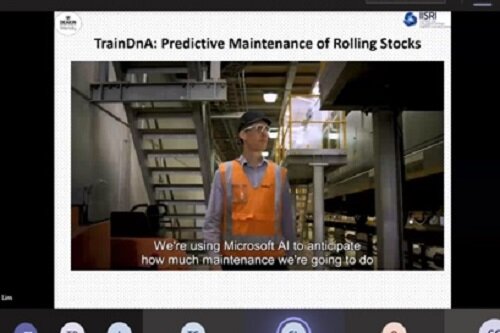
He also worked on the project to capture 30,000 signals every 10mins for each of the 78 trains on the Sydney network. This was to monitor the operation of the brake, air con, cabin doors, and so forth, using the data collected for predictive maintenance and servicing.

PREDICTIVE MAINTENANCE AND SERVICING OF TRAINS IN SYDNEY, USING CI.
Prof Lim applied the fuzzy model framework in Failure Modes and Effects Analysis (FMEA) in factories, and in the bird nest industry. This was to help the industry to have more structure in their processes and improve the quality of their processing to meet I SO standards.
Lastly was the multi-objective scheduling project for the furniture industry, where the aim was to devise optimal schedule for cost savings, tardiness and earliness of the production floor.

During Q&A, he highlighted Deakin’s teleoperation work such as surgical robots able to perform surgery from long distance, and scanning patients remotely for non-contact screening.
On the application of machine learning (ML) in the factory environment, he said both ML and CI involve algorithms and learning from data. They are yet to become turn-key technologies and the algorithm needs to be fine-tuned to solve specific problems.SCHEDULING FOR EFFECTIVE OPERATION.


