


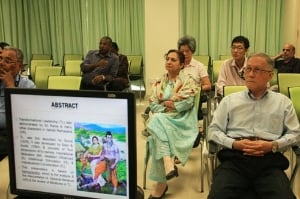
The example of transformational leadership exhibited by Rama in the Ramayana epic can be used as a model for leaders at the different levels of an organisation, society or a country.

This was expressed by WOU’s School of Business and Administration (SBA) Senior Lecturer Dr Balakrishnan Muniapan in his talk on “Valmiki Ramayana and its Relevance for Transformational Leadership” held at the main campus today under the auspices of the WOU Seminar Forum.
He said that one should look beyond the religious text and examine Ramayana in the context of leadership. The epic on the life, character and journey of Rama, the son of a king, provides an ‘inside-out’ approach, focusing on leader development or self-leadership first, rather than on the process of leadership.
Quoting scholars, Dr Bala remarked, “Transformational leadership is a process that motivates followers by appealing to higher ideals and values. Transformational leaders are able to define and articulate a vision and mission for their organisation, and their leadership style can transform their followers towards higher performance.”

He compared transformational leadership to transactional leadership which stresses on rewards and fulfilling the current needs of followers. “In transformational leadership, a leader’s source of power is ‘character, competence’, and change occurs in the follower’s attitude, values, with the focus being on development. In transactional leadership, the leader’s source of power is ‘rank, position’, and change occurs in the follower’s behaviour, with the focus on evaluation.”
He continued, “A transformational approach is likely to be more effective in overcoming barriers to change in organisations than a transactional style that concentrates on technical problem solving and which neglects people and organisation issues.”
Dr Bala highlighted the characteristics of transformational leaders, as exemplified by Rama in Ramayana. They are: change agents; courageous; believe in people; value-driven; lifelong learners; able to deal with complexity, ambiguity and uncertainty; and visionaries. “An important component of leadership is integrity, able to keep your word, walk the talk,” he declared.
He represented WOU as a speaker at the International Ramayana Conference on the theme of ‘Heal the World through Ramayana’ held in Mauritius from 22-24 August


