


In the age of information technology, consumers must exercise caution and take preventive measures to protect their computer systems against malware and hacking.
In his public lecture titled ‘Malware-proof Computing and Secure Data Communication’ at the main campus today, Prof Wolfgang A. Halang, Chair of Computer Engineering from Fern Universitat, Germany, said that even computer systems of big corporations are vulnerable to hacking. He cited the latest intrusion of Nissan’s website by the hackers group Anonymous.
He elaborated that malware or malicious software refers to intrusive or disruptive software like computer viruses, worms, and Trojan horses. He said that it is possible to build operating systems with adequate measures to thwart the threat of malware.

STAFF LISTENING TO THE TALK ON COMPUTER MALWARE.
He lamented that inadequate computers are employed even for safety-related tasks, and since computers are more and more connected to networks, they are thus endangered by malware. He said firewalls cannot protect intranets against external attacks, and so new appropriate architectures for their hardware and software are needed.
“Malware can permanently and securely be prevented by constructive, hardware-supported security measures only. Classical mainframe computers, for instance, have never been hacked or infected by malware so far,” Prof Halang stressed.
He noted that the Harvard architecture, which dates back to 1936, is immune to malware infection. “It separates data from instructions all the way down to the register level. All kinds of malware are disabled if instructions are write-protected by hardware in a way not susceptible by software.”

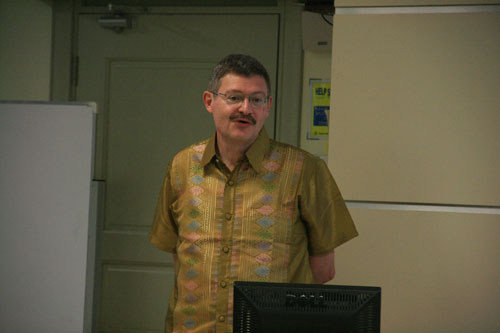
PROF HALANG.
He mentioned a few solutions to prevent malware, such as memory segmentation. “To prevent malicious software to interfere with system and application programs, mass storage must be partitioned into at least two segments. At least one segment, particularly safety-related data and programs, must be equipped with a hardware-implemented write-protection. In further segments not protected this way, frequently changing data are stored.”
Another solution is context-sensitive memory allocation that protects data against programs trying to spy and modify by precluding any unauthorised access, he added. As a rule of thumb, he summarised that only computers adequately constructed right from the start are secure against attacks and intrusion.

ELABORATING ON HOW TO KEEP COMPUTERS SAFE.
His advice to consumers: “Present operating systems that you buy in the shop are not malware-proof unless consumers ask for it. People should buy computers that are specially designed to be malware-proof, such as classical mainframe computers, which have never been hacked. Banking is mainly run on mainframe computers.”
Finally, he also cautioned computer users to “Be careful, and do not go to strange websites, but one you know belong to serious companies. Also, do not exchange your USB sticks (pendrive) or use the sticks in any computer. The main step to protect your data is to ask for safe computers.”


