


The views of Bengali poet Rabindranath Tagore were expounded during a lecture on ‘Building bridges across the Bay of Bengal: Tagore and his contemporaries’ held at Wawasan Open University.

PART OF THE CROWD AT THE LECTURE.
The talk – organised by Think City and Penang Heritage Trust (PHT) with the support of WOU and the Indian High Commission in Malaysia – explored the intellectual, cultural and political conversations across Asia conducted by Tagore and his contemporaries, thereby providing fresh insights into the modern intellectual history of Asia.
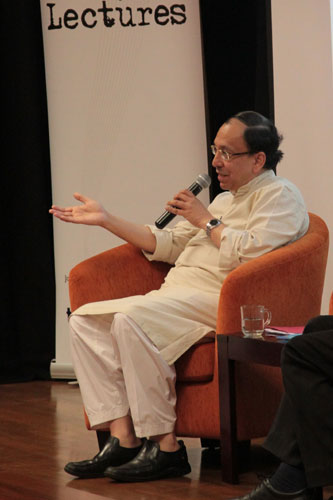
Prof Sugata Bose, a Gardiner Professor of History from Harvard University, stated, “The idea of Asia-sense or Asian universalism is contained in the writings of Asian thinkers even during the period of European colonial domination.”

PROF BOSE SHARES ON TAGORE.
He talked about Tagore’s trips to Penang, Singapore, Burma, Jogjakarta, Hong Kong, China, Iran and Iraq in the 1920s and 1930s, during which he forged powerful connections across Asia as Tagore believed in the virtues of close interaction among the Asian cultures.
He said Tagore promoted ‘universalist’ aspirations where colonised countries did not build walls around their cultural differences, but sought to merge and play a role in shaping the global future. According to Prof Bose, “A world historical transformation is under way in the early 21st century as Asia recovers the global position it had lost in the late 18th century.”

THE INDIAN HIGH COMMISSIONER TAKES HIS TURN AT THE PODIUM.
He shared that Tagore adopted an anti-colonialist stance and was against Asian nations catching the European culture of imperialism. Prof Bose said that both Tagore and his grand-uncle, India’s famous freedom fighter Netaji Subhas Chandra Bose, were critical of Japanese military adventurism in the early decades of the 20th century.
Replying to a question on the early influences that shaped Tagore’s “universal humanity” philosophy, Bose said Tagore detested narrow-minded religious bigotry and wanted people to respect religious differences and rise above them.
Some 200 guests attended the talk including the speaker’s mother Mrs Krishna Bose, Indian High Commissioner Mr Vijay K. Gokhale, Penang State Executive Councillor Dato’ Abdul Malik Abul Kassim, Think City chairman Dato’ Anwar Fazal, and PHT President Khoo Salma Nasution. Also present from WOU were Assistant Vice Chancellor (Academic Support) Prof Mohandas Menon, Dr Lalita Sinha (School of Education, Languages and Communications) and Sovindar Kaur (Registry).

PROF BOSE AUTOGRAPHS HIS BOOK. AT RIGHT IS HIS MUM.
Rabindranath Tagore lived from May 7, 1861 till Aug 7, 1941. He was Asia’s first recipient of the Nobel Prize for Literature in 1913 for ‘Gitanjali’, a collection of Indian poems. He wrote the national anthems of India and Bangladesh.


