


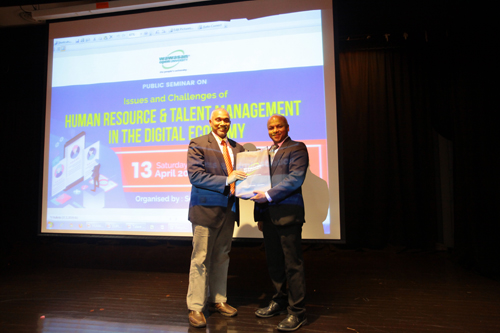
[WOU held a public seminar on “Issues and Challenges of Human Resource and Talent Management in the Digital Economy” at the main campus on April 13th. Over 50 people attended the talks under the event organised by the School of Business & Administration (SBA) and funded by the Institute for Research & Innovation (IRI).]

SCHOOL OF BUSINESS & ADMINISTRATION ACTING DEAN PRAKASH ARUMUGAM DELIVERS HIS OPENING REMARKS.
Employee engagement is a must in all organisations to enhance employee performance, employee retention and employee commitment towards his/her job.
Speaking on ‘Employee Engagement’, Human Resources Director of MIMOS, Parameswaran Ayahoo said that the advent of new technology and big data affects how people are engaged at the workplace.

PARAMESWARAN SHARES ON EMPLOYEE ENGAGEMENT.
He defined employee engagement as a two-way communication at the workplace to connect with an employee emotionally and mentally”. He added, “There needs to be a bond between you and the employee, only then are you connected and engaging with them.”
“If an employee feels disconnected from the organisation, it will affect his performance. By engaging the employees, we can motivate them so that they can best contribute towards the organisation’s goals, and we get their commitment, trust and loyalty.”

EMPHASISING WHY EMPLOYEE ENGAGEMENT IS IMPORTANT.
He highlighted that an engaged employee is high performing, committed, efficient, and there is no discipline or behavioural issue, while a ‘not engaged’ worker is less committed with minimal effort, little passion, little motivation, lack of creativity, and increased absence. “Actively disengaged employees are disruptive, very miserable, bad attitude, often late or absent, wastes time, don’t follow instructions, insubordination, and undermines co-workers.”
Parameswaran shared that employee engagement can be measured by a pulse survey, one-on-one dialogue, stay/exit interview and employee feedback channels.

EMPLOYEES MUST FEEL CONNECTED TO THE ORGANISATION, DECLARES PARAMESWARAN.
“We need the employee to contribute to the organisation’s KPI, goals, vision and mission, and so we must determine the employee engagement level at the organisation. Only then can we know what intervention initiatives can be undertaken to overcome disengagement and enhance organisation culture.” Activities like sports day and family day are examples of employee engagement.
He said that the challenge is to do employee engagement for the four types of workforce generation, that is, baby boomers (1946-1964), Gen X-ers (1965-1979), millennials/Gen Y (1980-1995), and Gen Z-ers (born after 1996). He pointed out the work traits of the different generation in regards to work ethics, optimism, passion, average tenure, digital fluency and such.

THE SPEAKER SHOWS HOW TO ENHANCE EMPLOYEE ENGAGEMENT.
He said the biggest workforce groups now are the Gen Y and Gen Z, and so we need to know what their expectations are and how to engage them. He also said that the skills gap of Gen X or baby boomers must be narrowed by upskilling so as to meet the organisational KPI.
He remarked that technology now makes a thin line between work and leisure, since people can work 24/7 from home and during weekends or holidays, and so you can still engage them. “Millennials and Gen Z are leading this trend, while Gen X hardly respond to WhatsApp messages on weekends.”

PRAKASH PRESENTS A TOKEN OF APPRECIATION FROM THE UNIVERSITY TO PARAMESWARAN.
He cited 5 ways to enhance employee engagement, and they are: transparency and build trust; align employees to organisation’s vision and mission; provide supportive work environment to perform their job; reward and recognise employees; and employee empowerment in decision-making.
He concluded that human interaction in employee engagement can never be fully replaced by technology, with platforms such as Facebook, WhatsApp, merely a tool to enhance engagement.

FROM LEFT: PRAKASH, PARAMESWARAN AND MODERATOR OF THE TALK, ASSOC PROF DR BALAKRISHNAN MUNIAPAN.
He suggested employers balance skills of workers with their potential/attitude, clarifying that skills can be taught easily while attitude is difficult.


